
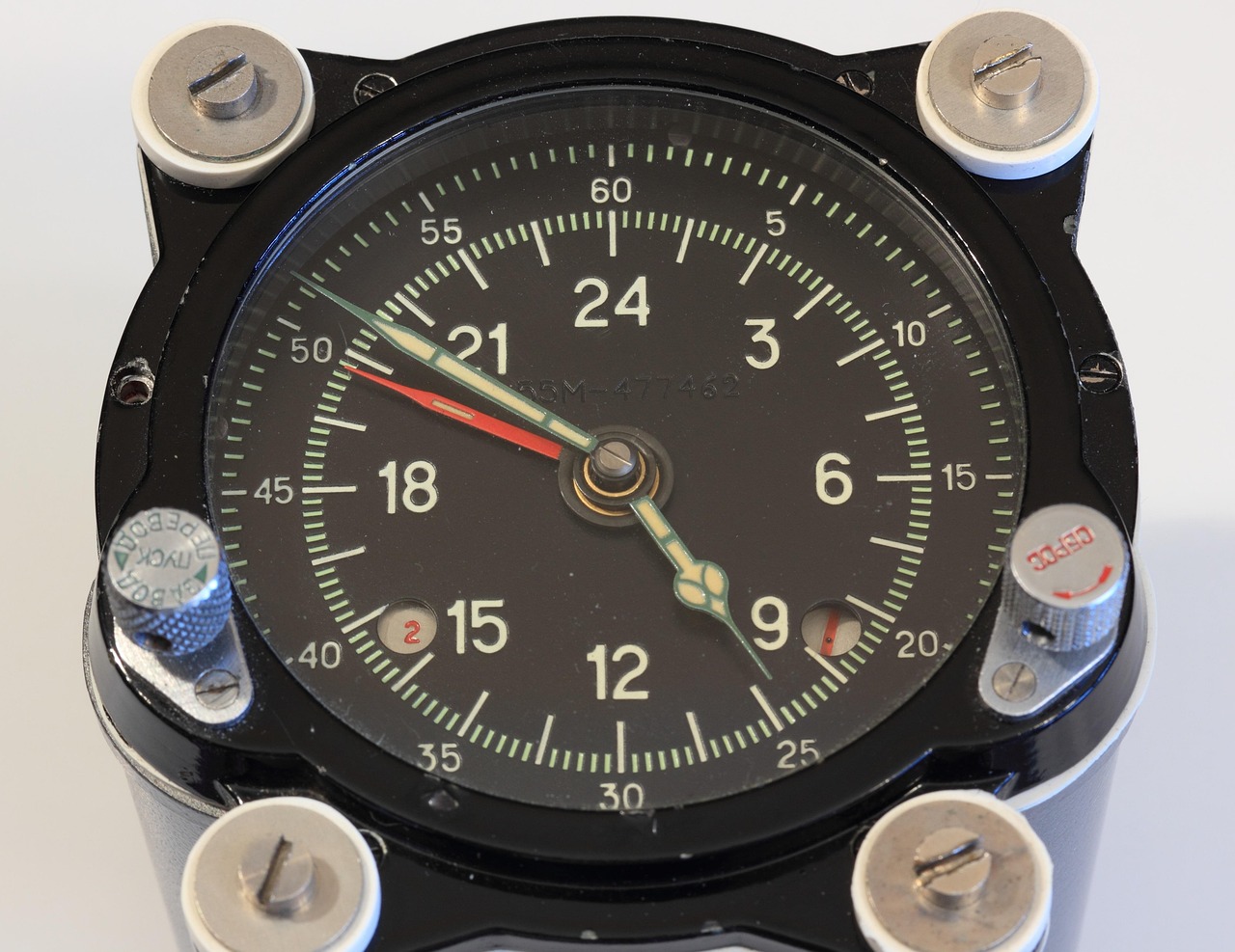
A conventional watch hides an ambiguity: its hour hand laps the dial twice daily, trusting your senses to distinguish 7 AM from 7 PM. The 24-hour dial removes the trust — one revolution per day, every hour with its own position — at the cost of a face where the hand crawls at half speed and casual reading takes practice.
Last updated: July 22, 2026
The design earned its keep where day and night stop helping. Long-haul and military pilots crossing zones adopted 24-hour watches to keep unambiguous Zulu time; the Glycine Airman of 1953, built at airline pilots’ request, became the archetype and flew on wrists through the jet age. Polar scientists live under midnight sun or noon darkness for months, where only a single-revolution dial (or discipline with a digital one) keeps 10:00 and 22:00 from blurring. Submarine crews, sealed from the sky entirely, run their vessels on 24-hour ship time for the same reason.
A related complication conquered general aviation and travel: the GMT hand. Introduced on the Rolex GMT-Master in the 1950s for Pan Am’s new intercontinental crews, it adds a fourth hand circling once per day against a 24-hour bezel — home time and destination time on one dial, the two-timezone life made legible. “GMT watches” remain a thriving category for exactly the customers who also use the converter tools this site offers.
History’s precedents run deep: Florence’s 1443 Uccello clock and many medieval astronomical dials counted all 24 hours in one sweep, since they modeled the sun’s daily circle directly; Prague’s Orloj still shows old Bohemian 24-hour time on its outer ring. The twice-around 12-hour dial won domestic life mainly for mechanical simplicity and finer minute-reading.
Digital displays settled most of the world on a compromise — 24-hour numerals without hands — which is why timetables read 18:45 even in 12-hour countries.
Whether your wrist counts to 12 or 24, the toggle at ellatime.com renders every world city both ways — noon at the top for the pilots, PM for everyone else.
Reading one takes a day of adjustment and then becomes oddly philosophical: the hand’s position is the day itself — morning climbing the left, evening descending the right, the whole waking arc visible at a glance the way a fuel gauge shows a tank. Devotees claim they plan differently once the afternoon is a visible remaining wedge rather than an abstraction; critics reply that squinting to distinguish 3:00 from 3:30 is a high price for philosophy.
The niche endures commercially — pilot brands, field watches, and one famous crossover in watches worn on polar expeditions and space stations, where crews orbiting through sixteen sunrises a day keep a single reference time on principle. Wherever the sky stops cooperating, the once-around dial quietly returns.
Choosing one today is mostly a statement about how you want to see a day — as two familiar laps, or one honest arc. Either way, the underlying convention is the same worldwide standard the timetables use, and switching between the two readings is a tap, not a philosophy, on the clocks of this site.
Related on Ellatime: Is Midnight 12 AM or 12 PM? Settling the Argument · Does the Week Start on Sunday or Monday? · GMT vs UTC: What's the Difference?
Further reading: Royal Museums Greenwich
Editorial Note: This article was researched and written by the Ellatime editorial team. We fact-check our content and update it regularly. For questions or corrections, contact us.
Related read: How to Calculate Age From a Date of Birth in 2026 (Without Mistakes).