
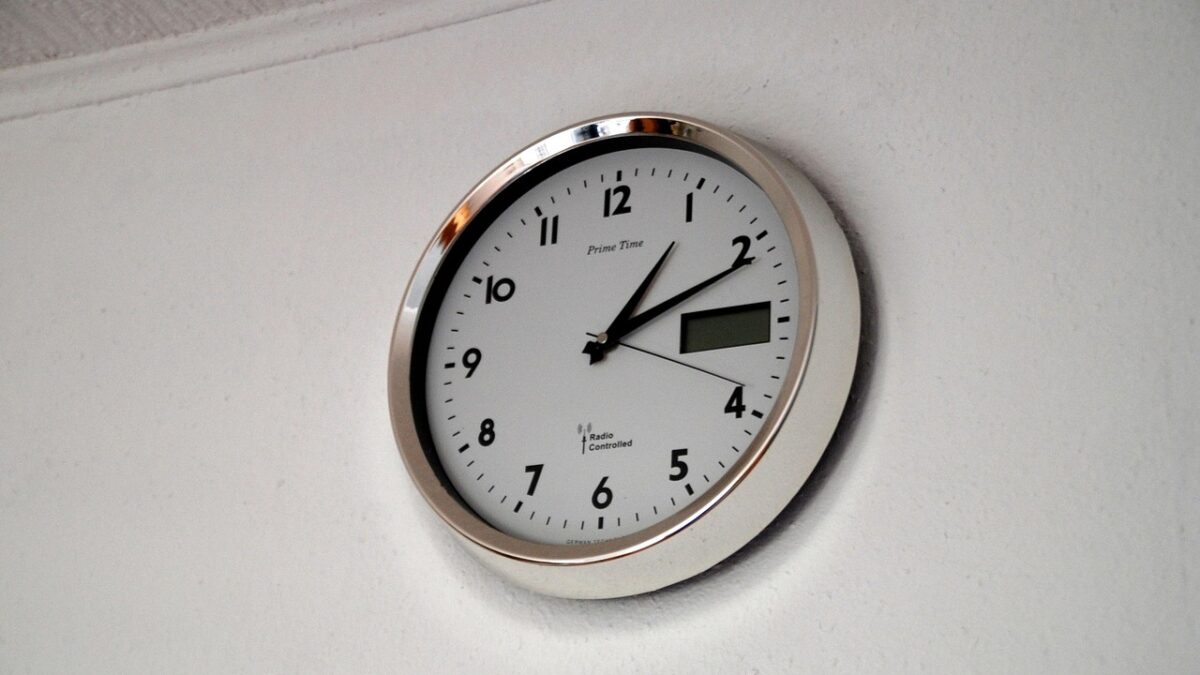
Since 1967, one second has had an exact physical definition: the duration of 9,192,631,770 oscillations of the microwave radiation that makes a caesium-133 atom flip between two energy states. That enormous number wasn’t invented — it was measured, chosen to match the old astronomical second as closely as possible so clocks wouldn’t jump when the definition changed. Every clock on Earth, from your phone to a stock exchange server, ultimately traces its beat back to atoms behaving this way in national laboratories.
Last updated: July 22, 2026
The mechanism is elegant. A caesium clock vaporizes atoms, sorts out those in one specific energy state, and bathes them in microwaves. When the microwave frequency exactly matches the atoms’ natural transition frequency, the maximum number of atoms flip states — and a detector confirms it. The clock continuously tunes its microwave generator to hold that peak, which locks the generator to the atomic frequency. Count the oscillations, and you are counting perfect seconds. The best caesium fountain clocks drift less than one second in 100 million years.
Why atoms? Because every caesium-133 atom in the universe is identical. A pendulum’s length changes with temperature; a quartz crystal ages; Earth’s rotation wobbles with tides and earthquakes. But an unperturbed atom’s transition frequency is a constant of nature, the same in Tokyo, Toronto, or a satellite in orbit. Atomic timekeeping replaced astronomy precisely because the heavens turned out to be the less reliable clock.
No single atomic clock rules alone. Around 400 atomic clocks in more than 80 laboratories worldwide report to the International Bureau of Weights and Measures near Paris, which averages them into International Atomic Time and, with occasional adjustments, produces UTC — the time your devices quietly sync to over the internet.
The next generation is already ticking. Optical clocks, which use atoms like strontium and ytterbium oscillating hundreds of trillions of times per second, are roughly 100 times more precise than caesium — accurate to about one second over the age of the universe. They can detect the tiny slowing of time predicted by Einstein when a clock is raised just a few centimetres in Earth’s gravity, which may eventually turn clocks into instruments for measuring altitude and mapping the planet’s interior.
For everyday life, the practical miracle is invisibility: your phone displays atomic time without containing an atomic clock, thanks to silent network synchronization. The live clock at ellatime.com shows that synchronized time down to the second, in any of 300+ time zones.
The finest caesium instruments, called fountain clocks, add a balletic refinement: lasers cool a cloud of atoms to near absolute zero and toss it gently upward through the microwave cavity, letting gravity bring it back down for a second pass. The longer, slower interaction sharpens the frequency measurement enormously — the same reason a longer pendulum keeps better time. National laboratories in the US, UK, France, Germany, and Japan run such fountains as their master references, and it’s their averaged, compared, and corrected output that becomes the world’s official second.
it’s a small piece of timekeeping with a long story — and like all of them, it ticks on quietly inside every date and clock at ellatime.com.
Related on Ellatime: The 23-Hour-56-Minute Day: Solar vs Sidereal Time · NTP: How Your Phone Knows the Exact Time · Why GPS Would Fail Without Einstein: Relativity in Your Pocket
Further reading: NIST Time and Frequency Division
Editorial Note: This article was researched and written by the Ellatime editorial team. We fact-check our content and update it regularly. For questions or corrections, contact us.