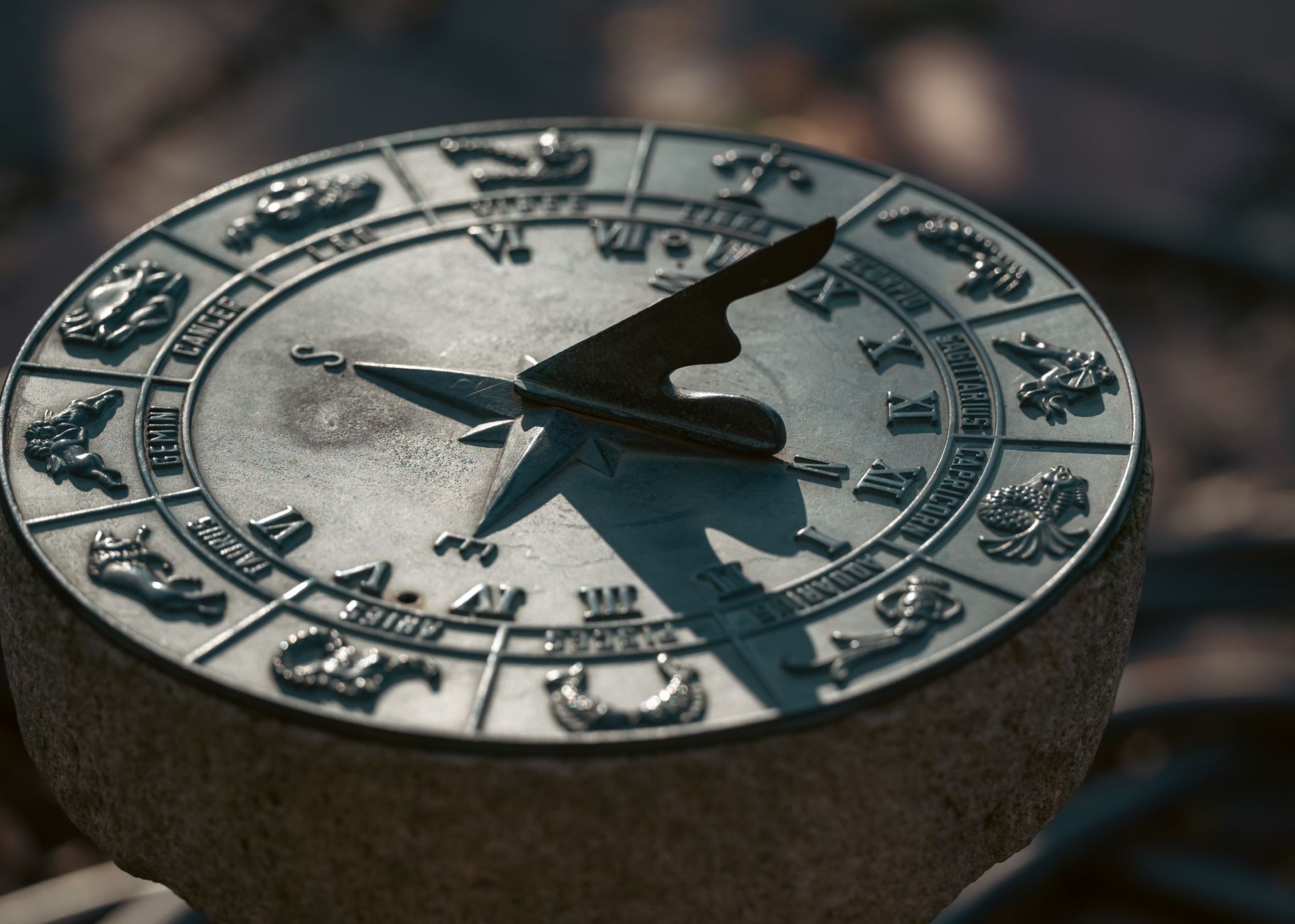
A sundial tells time with the sun’s motion across the sky: as the sun moves west, the shadow of a pointer — the gnomon — sweeps east across marked hour lines. Egyptians used shadow clocks by around 1500 BCE, and versions of the idea served as humanity’s primary timekeeper for three thousand years.
Last updated: July 22, 2026
The crucial design secret is the gnomon’s angle. It can’t simply stand vertical; it must lie parallel to Earth’s axis of rotation — tilted from the horizontal by exactly the local latitude and aimed true north (in the northern hemisphere, very close to Polaris). Aligned this way, the sun’s daily circle around the axis moves the shadow at a steady angular rate, so the hour lines stay valid all year. This is why a sundial made for Cairo reads wrong in London, and why garden-center sundials planted as ornaments rarely tell the truth: latitude and alignment are the whole trick.
Even a perfect sundial disagrees with your phone, for three honest reasons. First, longitude: the dial reads local solar time, but your civil time zone is set to a reference meridian that may be hundreds of kilometres away — four minutes of difference per degree. Second, the “equation of time”: Earth’s elliptical orbit and axial tilt make the sun run up to about 16 minutes fast or slow across the year, a correction old dials sometimes engraved as a looping figure-eight chart. Third, daylight saving adds a blunt extra hour in summer. Apply all three corrections and a good sundial agrees with an atomic clock to within a minute or two.
The form has endless variations — vertical dials on church walls, portable ring dials, the analemmatic dials in parks where a human stands as the gnomon on a date-marked line — and one poetic convention: mottoes. Sundials traditionally carry inscriptions about mortality and light, from “I count only the sunny hours” to “it’s later than you think.”
The sun that drives every dial is the same one whose rise, transit, and set are computed for any location in the sun times panel at ellatime.com — solar noon there’s precisely the moment a true sundial’s shadow touches XII.
The grandest sundials hide inside churches. From the 15th century, cathedrals in Italy and France embedded meridian lines in their floors: a small hole high in the wall projects the sun’s image, which crosses an inlaid brass line at exact solar noon, its position along the line marking the date. Built to pin down Easter’s astronomy, instruments like the meridians of Bologna’s San Petronio and Paris’s Saint-Sulpice turned entire buildings into precision solar instruments — sundials the size of naves.
The sundial’s afterlife is everywhere once you look: the analemma — that slender figure-eight printed on globes — is simply the sun’s noon position photographed across a year, the equation of time drawn by the sky itself. Navigators used solar altitude with sextants long after clocks matured; solar-panel installers and architects still run the same geometry to place windows and arrays; and the phrase “a place in the sun” keeps the old instrument’s logic alive in language. The gnomon’s shadow was humanity’s first data visualization, and it never really stopped working.
Related on Ellatime: Before Mechanical Clocks: Water Clocks, Hourglasses, and Candle Time · The Oldest Working Clocks in the World · The Speaking Clock: When People Telephoned to Ask the Time
Further reading: North American Sundial Society
Editorial Note: This article was researched and written by the Ellatime editorial team. We fact-check our content and update it regularly. For questions or corrections, contact us.
Related read: Fiscal Year vs Calendar Year: Why Governments Don't Start in January in 2026.