
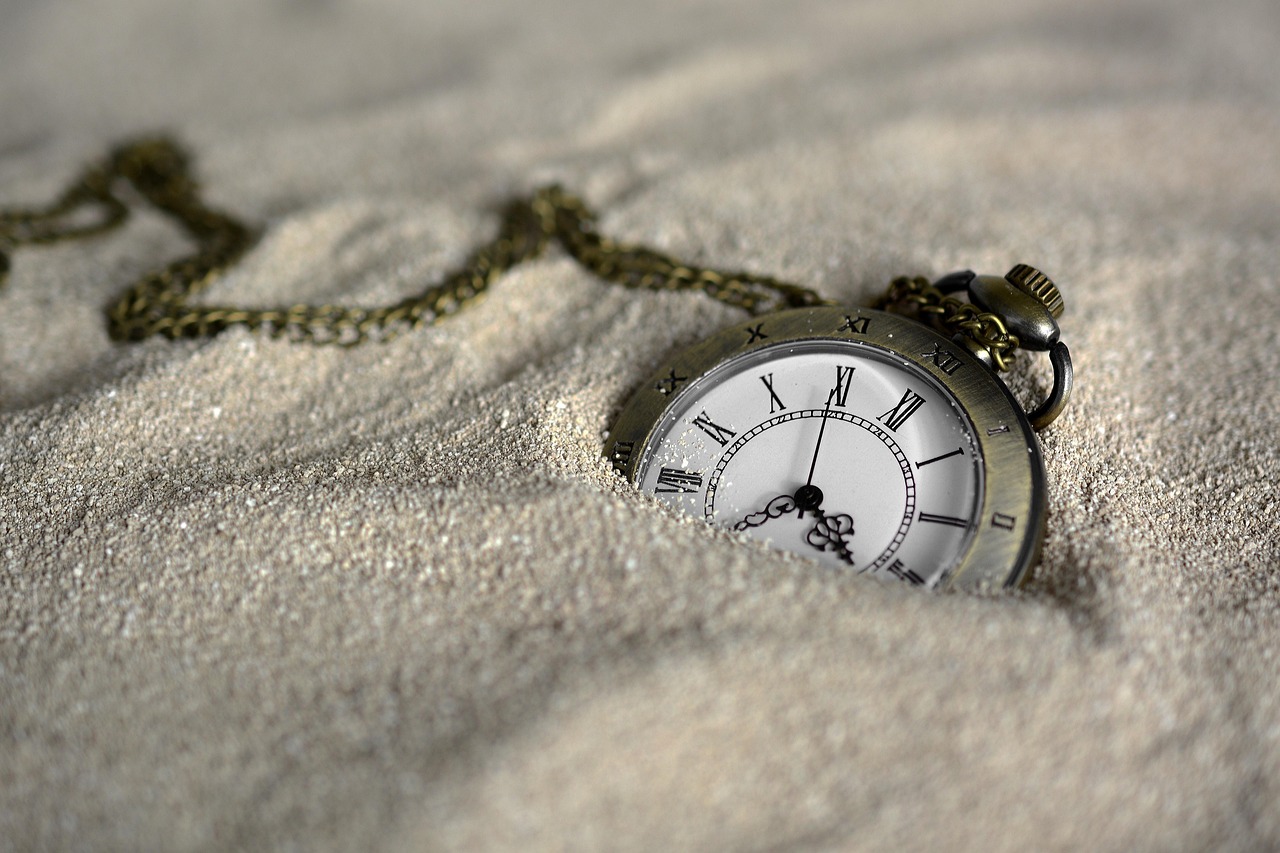
Clockwise motion is a fossil of geography. In the northern hemisphere, where mechanical clocks were invented, the sun crosses the southern sky — rising in the east, standing south at noon, setting west. A horizontal sundial’s shadow therefore sweeps in the sequence west, north, east across the dial: precisely the motion we now call clockwise. When European craftsmen built the first mechanical clock faces in the fourteenth century, they naturally copied the only rotating time display anyone knew.
Last updated: July 22, 2026
Had clockmaking arisen south of the equator, the convention would almost certainly run the other way: an Australian or Argentine sundial’s shadow travels counterclockwise, because the southern-hemisphere sun crosses the northern sky. Our “clockwise” is thus not a law of nature but a vote cast by latitude — northern Europe happened to hold the patent office of horology.
Exceptions exist and delight visitors. Florence’s cathedral houses Paolo Uccello’s 1443 clock, a 24-hour face whose single hand runs counterclockwise by the old Italian reckoning. A famous clock on Prague’s Jewish Town Hall bears Hebrew numerals and turns counterclockwise, following the right-to-left direction of Hebrew script. And in 2014 Bolivia reversed the clock on its congress building in La Paz, running it counterclockwise as a deliberate statement of southern-hemisphere identity — a “clock of the south” that tells perfectly correct time backwards.
The convention seeped far beyond clock faces: screws tighten clockwise, dials and knobs increase clockwise, board games move clockwise, and “counterclockwise” itself is defined by the clock. Racetracks are a curious rebel — most modern athletics and horse racing turn counterclockwise, a tradition with its own contested history.
Even the words wear the fossil. Before clocks, English described rotation as “sunwise” or the Scottish “deasil” — with the sun — versus the ill-omened “widdershins,” against it. The clock merely mechanized the sun’s direction and lent the motion its modern name.
Every analog clock at ellatime.com spins the same inherited way — a small daily tribute to northern sundials, paid faithfully on both sides of the equator.
The sundial inheritance shows up in the numbers’ placement too: twelve stands at the top because noon — the shadow pointing due north on a northern dial — was the day‘s anchor, and early public clocks were noon-checked against the sun daily. Some medieval faces put I through XII twice around a 24-hour ring before the familiar doubled 12-hour sweep won out for legibility.
Psychologists note how deep the convention now runs: people asked to “rotate forward” almost universally gesture clockwise, progress bars and loading spinners circle clockwise, and even abstract diagrams of cycles — seasons, product lifecycles, the water cycle — default to it. A hemisphere’s accident of sunlight became, through the clock, the human default for the direction of time itself.
So the answer to the child’s question is satisfyingly complete: clocks run clockwise because shadows did, shadows did because the inventors lived north of the equator, and everyone else inherited the habit along with the machine. Direction, like so much in timekeeping, is frozen history.
Related on Ellatime: Before Mechanical Clocks: Water Clocks, Hourglasses, and Candle Time · The Oldest Working Clocks in the World · The Speaking Clock: When People Telephoned to Ask the Time
Further reading: Encyclopaedia Britannica — Clock
Editorial Note: This article was researched and written by the Ellatime editorial team. We fact-check our content and update it regularly. For questions or corrections, contact us.
Related read: Why Prayer Time Apps Disagree: Calculation Methods Explained.